

The ‘Phad’ Painters of Shahpura: Preserving a 700-Year-Old Storytelling Tradition
1/7/2026
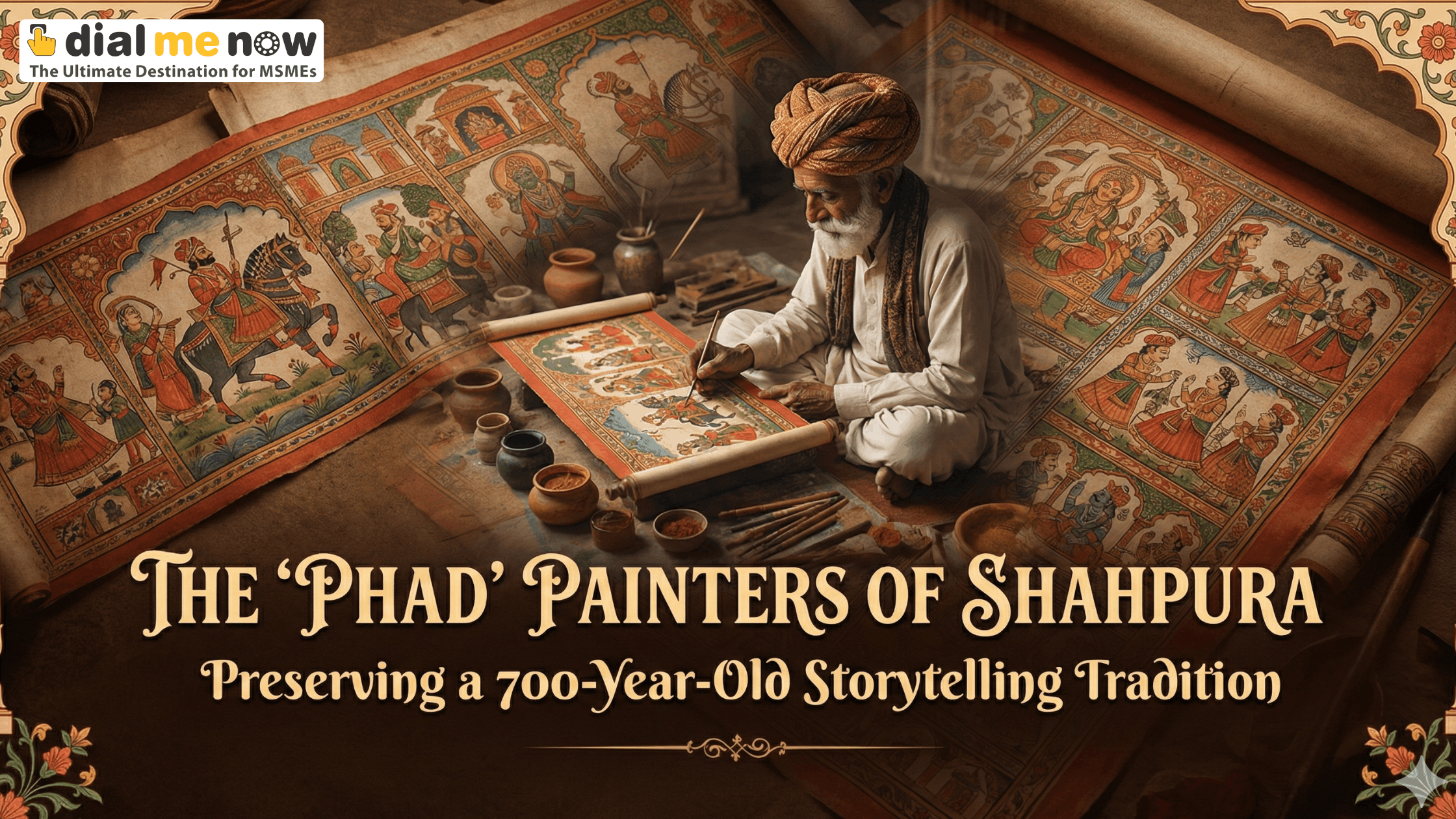
In the quiet town of Shahpura, nestled in the Bhilwara district of Rajasthan, a vibrant visual legacy has been unfolding for seven centuries. Known as Phad painting, this ancient art form is not merely a decorative craft; it is a sacred, rollable temple, a complex comic strip of divinity, and a vital medium for oral storytelling that refuses to fade into the pages of history.
As we move through 2026, Phad painting has transcended its rural roots to become a global symbol of Rajasthani heritage. This guide explores the intricate world of the Joshi family, the master painters who have guarded this “clandestine” art for generations, and the Bhopas, the priest-singers who bring these scrolls to life under the desert moonlight.
What is Phad Painting? The “Traveling Temples” of Rajasthan
The word ‘Phad’ likely originates from the Sanskrit word Patt (flat surface) or the local Rajasthani term for “fold.” Historically, these paintings were commissioned by the Rabari community—pastoral nomads who were constantly on the move. Since they could not visit stationary temples, they commissioned the Joshi painters of Shahpura to create “Traveling Temples.”
A traditional Phad is a long, horizontal cloth scroll (sometimes up to 30 feet long) densely packed with figures, animals, and palaces. Every inch of the canvas is utilized, creating a visual rhythm that supports an elaborate night-long performance called Phad Bachana (reading of the scroll).
The Epic Narratives: Devnarayan and Pabuji
While Phad artists today paint themes from the Ramayana and Mahabharata, the heart of the tradition lies in the epics of two local folk heroes:
- Pabuji Ki Phad: Depicts the life of Pabuji, a 14th-century Rajput chieftain revered as the protector of livestock and an incarnation of Lord Lakshman.
- Devnarayan Ki Phad: Chronicles the miracles of Devnarayanji, a warrior-deity believed to be an incarnation of Lord Vishnu. His Phad is traditionally the longest and most complex, often spanning 35 feet.
Unlike modern art, Phad paintings do not use linear perspective. The size of the figure depends on its social or divine status rather than its distance from the viewer. The central deity is always the largest, while secondary characters and commoners are depicted in smaller scales.
The Sacred Craft: How a Phad is Born
The creation of a Phad is a labor-intensive, ritualistic process that can take weeks or even months. To this day, master artists like Kalyan Joshi and Vijay Joshi adhere to natural, eco-friendly methods.
The Canvas (Kutai)
- Preparation: Coarse cotton cloth (Khadi) is soaked overnight and treated with a starch made from boiled rice or wheat flour.
- Polishing: Once dry, the cloth is rubbed with a smooth moonstone or cowrie shell (Mohra) until it achieves a glossy, stone-like sheen that ensures the colors remain on the surface rather than soaking in.
The Natural Palette
Every color in a Phad has a specific symbolic role and is derived from nature:
- Yellow (Hardal): Used for initial sketching.
- Orange (Kesariya): For skin and limbs.
- Green (Hara): For trees and vegetation.
- Brown (Geru): For architectural structures.
- Red (Lal): For royal attire, flags, and the thick floral border.
- Blue (Neela): For water or curtains.
- Black (Siyahi): The final step—outlining the figures and bringing them to life.
The Performance: Phad Bachana
A Phad is never “complete” until it is performed. The Bhopa (priest) and his wife, the Bhopi, travel from village to village.
- The Orchestra: The Bhopa plays the Ravanahatha, a two-stringed fiddle, while singing the verses of the epic.
- The Spotlight: The Bhopi dances and holds a small oil lamp (Diya) to highlight the specific scene on the scroll that her husband is narrating.
This performance traditionally happens after sunset and lasts until the early hours of the dawn, turning a village square into a sacred theater.
The Joshi Family: Guardians of the Clandestine Art
For centuries, Phad painting was a closely guarded secret of the Joshi family of Shahpura. In a fascinating piece of social history, the art was never taught to the daughters of the house—only to the daughters-in-law. The logic was that a daughter would marry into another family and take the secret with her, whereas a daughter-in-law would preserve it within the Joshi lineage.
This changed in 1960 when the legendary Shree Lal Joshi (a Padma Shri recipient) realized the art form was dying. He broke tradition and founded Chitrashala, the first school to teach Phad to students outside the family. Today, his sons, Kalyan Joshi and Gopal Joshi, and other descendants like Vijay Joshi, continue to innovate while keeping the 700-year-old soul of the art alive.
Phad in 2026: Modernity and Resurgence
Phad has evolved to survive in the modern world. While the 30-foot scrolls remain for ritual use, artists have adapted the style for:
- Home Decor: Mini-Phads (2–4 feet) that fit modern living rooms.
- Contemporary Themes: Phad paintings depicting the COVID-19 pandemic, ecological conservation, and even animated Phad movies.
- Global Recognition: Phad artworks now adorn the walls of the Prime Minister’s Office in India and prestigious museums in London and Berlin.
❓ Frequently Asked Questions (FAQ)
Q1: Why are the figures in Phad paintings always in profile? A: This is a stylistic hallmark of the Mewar school. Figures face each other to depict dialogue and action within the narrative, but they never face the audience directly.
Q2: Can I buy an authentic Phad painting online? A: Yes, many master artists like the Joshi family have their own websites. However, ensure you are buying from a verified source to support the actual artisan community.
Q3: Is Phad painting still used for religious purposes? A: Absolutely. While many Phads are now sold as art pieces, the Bhopa and Bhopi communities still use them as mobile temples for religious services in rural Rajasthan.
Q4: Why aren’t Phad paintings signed by the artists? A: Traditionally, Phad paintings were considered religious offerings rather than individual artistic expressions. While modern pieces for decor might be signed, traditional ritual scrolls remain unsigned.
Q5: What makes Phad different from other Rajasthani paintings? A: Phad is a performance-based scroll art. Unlike Miniature or Pichwai paintings, its composition is specifically designed to be read and sung as a sequential narrative.
Q6: Are the colors used in Phad paintings permanent? A: Yes. The combination of natural minerals and gum arabic, along with the intense polishing process, makes the colors extremely durable against heat and humidity.
Q7: Can women be Phad painters? A: Today, yes! Since Shree Lal Joshi opened the school in 1960, women—including both daughters and daughters-in-law of the family—have become accomplished Phad artists.
Q8: How long does it take to learn Phad painting? A: While a basic workshop can teach you the motifs in a few hours, mastering the freehand sketching and complex narrative layout takes years of dedicated practice.
Disclaimer
Phad painting is a living tradition with deep religious significance. When visiting studios or attending performances, travelers are encouraged to respect local customs and seek permission before taking photographs of sacred ritual scrolls.