

The ‘Near Me’ Revolution: How to Optimize Your Business Listing for Voice Search
2/4/2026
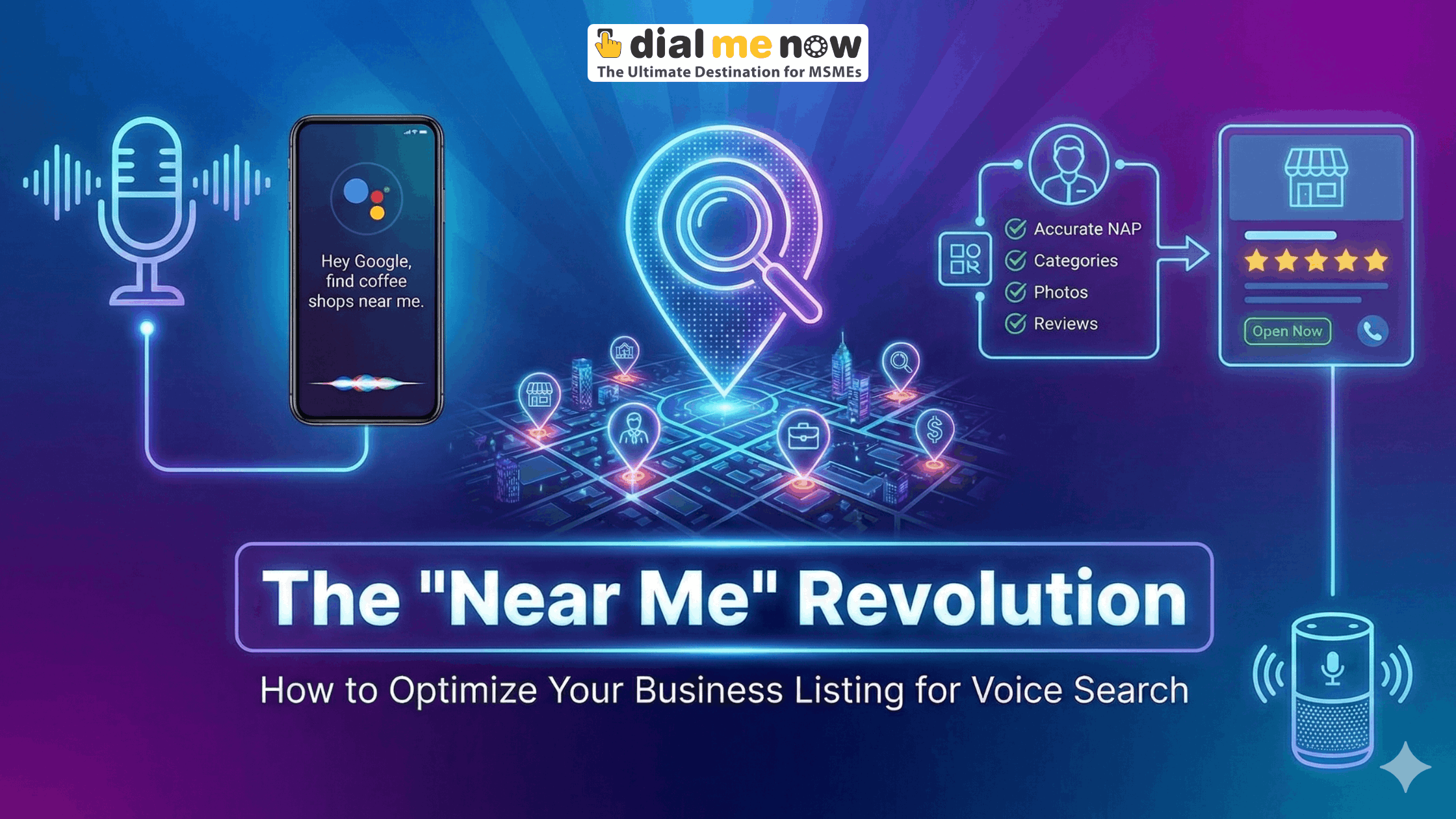
In the digital landscape of 2026, the way we search has shifted from the keyboard to the vocal cords. With the widespread adoption of AI-powered assistants like Gemini, Siri, and Alexa, the “Near Me” query has evolved from a typed convenience into a spoken command.
For local businesses—whether you are a high-end boutique in Jaipur, a café in Delhi, or a service provider in Bangalore—the “Near Me” revolution is no longer coming; it’s here. If your business isn’t optimized for voice search, you aren’t just losing clicks; you’re becoming invisible to the fastest-growing segment of the market. This guide will walk you through the essential strategies to ensure your business is the first answer when a customer asks, “Where is the best… near me?”
Why Voice Search is Different: The Conversational Shift
Traditional SEO was built on “fragmented keywords” (e.g., “Best Pizza Jaipur”). Voice search is built on Natural Language Processing (NLP).
- Longer Queries: When people speak, they use full sentences. Instead of “Plumber Delhi,” they ask, “Hey Gemini, find me a 24-hour plumber near me who can fix a leaky pipe.”
- Intent-Driven: Voice searches are often high-intent and urgent. Users are typically looking for an immediate solution, a phone number, or directions while on the move.
- The “Position Zero” Goal: While a screen shows 10 results, a voice assistant often only reads one. Being #2 is no longer enough; you need to be the “Featured Snippet” or the top-rated Google Business Profile.
The Pillars of “Near Me” Optimization
To dominate the voice search landscape in 2026, your business must master three core areas: NAP Consistency, Local Content, and Technical Schema.
A. Master Your Google Business Profile (GBP)
Your Google Business Profile is the primary source of truth for voice assistants.
- Complete Every Field: Don’t just list your name. Add your service area, specific categories (e.g., “North Indian Restaurant” instead of just “Restaurant”), and high-quality photos.
- Business Hours: Ensure they are 100% accurate. If a user asks, “Is the pharmacy near me open now?” and your profile says “Closed,” you lose the lead.
- Attributes: Use attributes like “Wheelchair accessible,” “Free Wi-Fi,” or “Outdoor seating.” Voice assistants often filter results based on these specific needs.
B. NAP Consistency (Name, Address, Phone)
Inconsistency is the silent killer of local SEO.
- The Rule: Your Name, Address, and Phone number must be identical across your website, Google, Yelp, Bing, and local directories (like JustDial or Yellow Pages).
- Why it matters: If one site says “Street” and another says “St.”, it creates a “trust gap” for the AI. The AI will prioritize businesses it is 100% sure about.
C. Use Structured Data (Schema Markup)
Think of Schema as a translator that tells search engines exactly what your data means.
- LocalBusiness Schema: Implement this on your website to explicitly tell Google your coordinates, opening hours, and price range.
- Speakable Schema: A newer 2026 standard that identifies sections of your website that are particularly “voice-friendly” for assistants to read aloud.
Voice Search vs. Traditional Search: A 2026 Comparison
| Feature | Traditional Web Search | Voice Search (Near Me) |
| Input Style | Short, choppy keywords | Long, conversational sentences |
| Search Volume | High (Desktop/Mobile) | Explosive growth (Wearables/Home AI) |
| Result Count | Page 1 (Top 10) | The “Answer” (Top 1-2) |
| User Intent | Information gathering | Immediate action/Location based |
| Local Focus | Important | Critical |
Content Strategy: Writing for the Ear
To rank for voice search, your website content needs to sound like a human conversation.
- Create a “Voice-Ready” FAQ Page: This is the #1 way to capture voice queries. Use the exact questions your customers ask.
- Instead of: “Our Services”
- Use: “What services does our salon in Jaipur offer?”
- Focus on “Hyper-Local” Keywords: Mention landmarks, neighborhoods, and nearby streets. If you are near the Hawa Mahal, include phrases like “best café near Hawa Mahal” or “walking distance from Johari Bazaar.”
- Keep it Concise: Voice assistants prefer answers that are roughly 29 words long. Provide a direct answer first, then elaborate.
The Power of Reviews: Your Voice Search Reputation
In 2026, AI assistants have a “bias” toward excellence. When a user asks for the “best” anything, the AI filters for ratings of 4.0 stars and above.
- The Recency Factor: It’s not just about high ratings; it’s about recent ones. A review from 2024 carries less weight for a “Near Me” query than one from last week.
- Keywords in Reviews: When customers use phrases like “best service in Jaipur” in their reviews, it signals to the AI that you are a relevant match for that specific voice query.
❓ Frequently Asked Questions (FAQ)
Q1: How do I know if my business is appearing in voice searches?
A: You can test this by using your own voice assistant (Gemini, Siri, etc.) and asking questions related to your services in your area. If you don’t appear in the top “Map Pack” results, you need optimization.
Q2: Is voice search only for restaurants and shops?
A: No. Service-based businesses (plumbers, lawyers, doctors, tutors) see some of the highest volumes of “Near Me” voice searches because the intent is often urgent.
Q3: What is “Position Zero”?
A: This is the “Featured Snippet” that appears above the regular search results. For voice assistants, this is the only result that matters because it is the one the assistant reads aloud.
Q4: Do I need a mobile-friendly website for voice search?
A: Absolutely. Most voice searches happen on mobile devices. If your site is slow or hard to navigate, Google will penalize your local ranking.
Q5: Can I optimize for voice search in regional languages like Hindi?
A: Yes! In 2026, AI assistants are highly proficient in regional languages. Using Hindi keywords and FAQs can help you capture a massive segment of the local market.
Q6: Does my business need to be open 24/7 to rank for “Near Me”?
A: No, but you will only rank for “Open Near Me” when your business is actually open. Ensure your hours are updated for holidays and weekends.
Q7: How important are photos for voice search?
A: While the assistant doesn’t “read” the photo, Google uses image data and engagement to rank your profile. Profiles with 100+ photos see significantly more “Directions” and “Call” requests.
Q8: What is the most important factor for “Near Me” rankings?
A: Proximity, Relevance, and Prominence. While you can’t change your location (Proximity), you can control your Relevance (Keywords/Schema) and Prominence (Reviews/Backlinks).
Disclaimer
Voice search algorithms are proprietary to tech giants like Google, Apple, and Amazon and are subject to frequent updates. While these strategies align with 2026 SEO best practices, local competition and search volume vary by industry and location. We recommend a consistent, multi-month SEO strategy for best results.
Conclusion
The “Near Me” revolution is transforming the phone from a tool we touch into a tool we talk to. By optimizing your business listing for voice search, you aren’t just following a trend—you are future-proofing your brand. In 2026, the businesses that win are the ones that are ready to answer the call.