

Solar Power in the Desert: Why Bhadla Solar Park is a Beacon for Green Energy Startups
1/29/2026
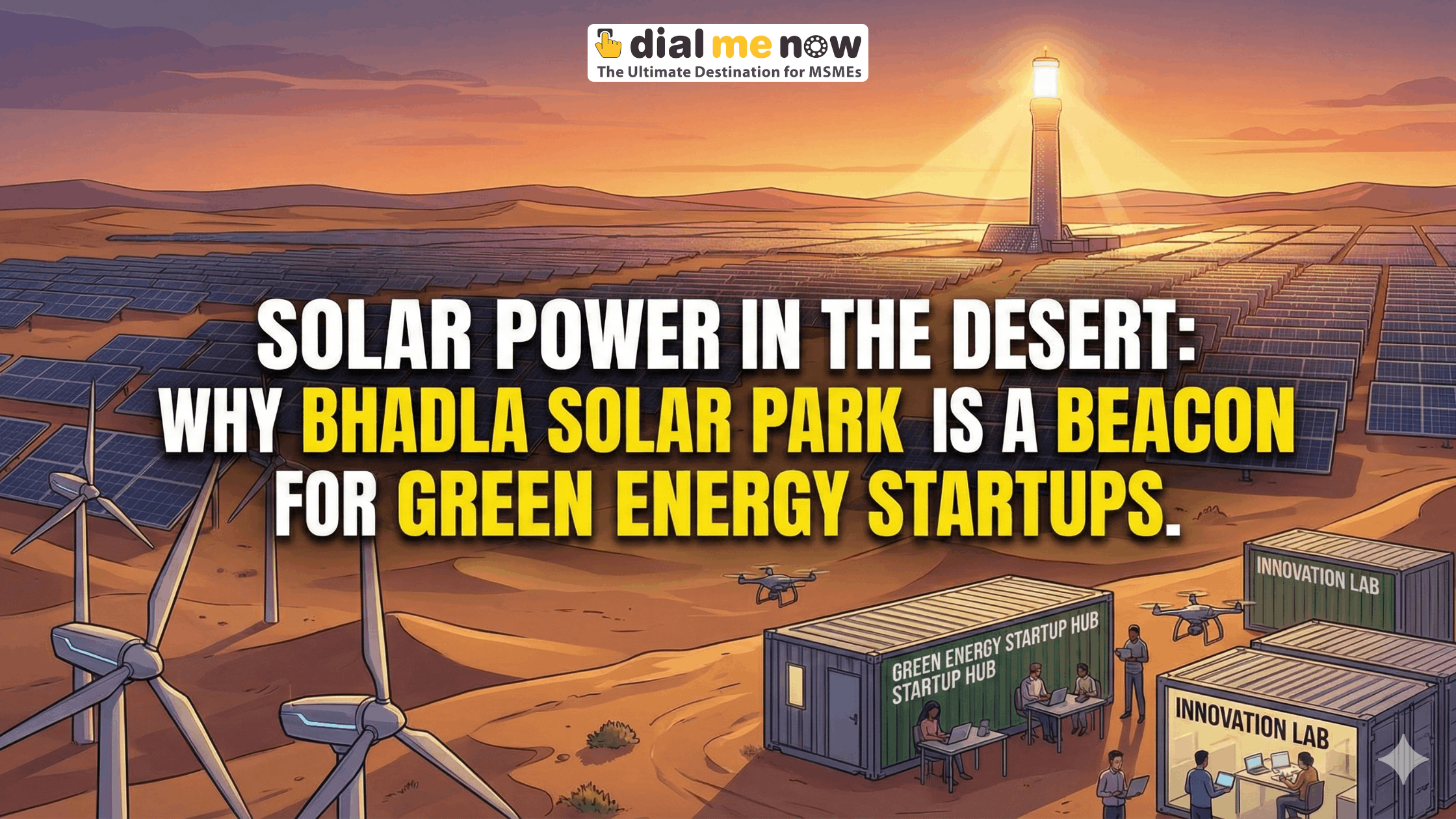
In the shimmering heat of the Thar Desert, where temperatures can soar to a blistering 48°C, lies a man-made marvel that is rewriting the global energy script. Bhadla Solar Park, spread across a staggering 14,000 acres in Rajasthan’s Jodhpur district, is not just a collection of glass and silicon; it is the world’s most powerful statement on renewable energy.
As we move through 2026, Bhadla remains a global titan with an installed capacity of 2,245 MW. But beyond the megawatts, it has become a “Silicon Valley in the Sand” for green energy startups. From robotic cleaning to AI-driven grid management, Bhadla is the ultimate testing ground for the future of clean tech.
The Anatomy of a Giant: Bhadla at a Glance
To understand why startups are flocking to this desert outpost, one must first appreciate the scale of the infrastructure. Bhadla was developed in four phases, attracting billions in investment from global players like NTPC, Adani, and SoftBank.
Key Statistics (2026 Update):
- Total Capacity: 2,245 MW (Generating approx. 732,874 MWh annually).
- Solar Panels: Over 10 million (1 crore) panels.
- Area: 56 square kilometers (roughly the size of San Marino).
- Carbon Impact: Reduces CO₂ emissions by an estimated 4 million tonnes every year.
Why Startups are Choosing the Desert
While the major developers own the panels, a massive ecosystem of specialized startups has grown around them. Bhadla offers a “Live Laboratory” with extreme conditions that prove a technology’s mettle.
A. Robotic Maintenance & Waterless Cleaning
In the desert, dust is the enemy of efficiency. Even a thin layer of sand can drop a panel’s output by 30%.
- The Innovation: Startups are deploying Ecoppia-style autonomous robots that clean panels without a single drop of water.
- The Opportunity: With over 2,000 robots already active, there is a booming market for specialized AI that can predict dust storms and trigger cleaning cycles.
B. AI-Driven Grid Management & Prediction
Solar energy is intermittent—the sun doesn’t always shine at the same intensity.
- The Innovation: Startups like Bluebird Solar are using machine learning to predict generation peaks with 99% accuracy, allowing the national grid to balance load effectively.
- The Opportunity: Software-as-a-Service (SaaS) platforms that integrate solar data with real-time grid demand are seeing massive VC interest in 2026.
C. Energy Storage Solutions (BESS)
As India pushes toward its 500 GW renewable goal by 2030, the focus in 2026 has shifted to Battery Energy Storage Systems (BESS).
- The Innovation: Niche firms are testing high-capacity lithium-ion and flow batteries at the Bhadla cluster to store excess daytime energy for nighttime use.
Government Incentives: The “Rising Rajasthan” Boost
The Rajasthan government, under its Renewable Energy Policy 2026, has created a “Red Carpet” for green tech entrepreneurs.
- Asset Creation Incentives (ACI): Startups can receive up to 75% SGST reimbursement for 7 years.
- Training & Skilling Subsidy: The state provides ₹4,000 per worker per month for training local youth in solar maintenance.
- Exemptions: 100% exemption from electricity duty and land tax for the first 7 years of operation.
The Bhadla Development Timeline
| Phase | Developer Focus | Capacity | Milestone |
| Phase I | RSPDCL (Nodal Agency) | 65 MW | The Pioneer phase |
| Phase II | RRECL / NTPC | 680 MW | Infrastructure scaling |
| Phase III | Saurya Urja (JV) | 1,000 MW | Record-low tariff (₹2.44) |
| Phase IV | Adani Renewable | 500 MW | Completion of the world’s largest park |
Challenges for Startups: The “Desert Tax”
Operating in Bhadla isn’t all sunshine and profits. Startups must navigate:
- Thermal Stress: Electronics fail faster in 48°C heat. Innovations in Phase-Change Materials (PCM) for cooling are high-demand.
- Logistics: Bhadla is remote. Building a reliable supply chain for spare parts requires significant planning.
- Grid Congestion: As more power is generated, the “Green Energy Corridor-II” (expected completion March 2026) is vital to prevent bottlenecks.
❓ Frequently Asked Questions (FAQ)
Q1: Is Bhadla still the largest solar park in the world in 2026?
A: Yes, with a commissioned capacity of 2,245 MW, it remains India’s largest and one of the world’s top operational solar parks.
Q2: Can a small startup get land inside Bhadla Solar Park?
A: Most land is allotted to large developers via auctions. However, startups can set up Ancillary Units (for cleaning, monitoring, or repair) in the surrounding industrial zones.
Q3: What is the lowest solar tariff achieved at Bhadla?
A: A historic low of ₹2.44 per unit was achieved during Phase III auctions, proving that solar is significantly cheaper than coal.
Q4: How are the solar panels cleaned in the desert?
A: Over 2,000 autonomous robots are used. These robots use soft microfiber brushes to clean panels without using water, preserving the desert’s limited resources.
Q5: Can I visit Bhadla Solar Park as a tourist?
A: It is a high-security industrial zone. While you can drive past the perimeter and see the vast fields of panels, entry into the core plant areas requires prior permission from the developers.
Q6: What other solar parks are there in Rajasthan?
A: Besides Bhadla, Rajasthan is developing mega-parks in Fatehgarh (Jaisalmer), Phalodi-Pokhran, and Pugal (Bikaner).
Q7: Does Rajasthan give subsidies for small businesses to go solar?
A: Yes, under the Rajasthan Solar Subsidy 2025-26, small businesses in mixed-use areas can get subsidies ranging from 25% to 45% of the installation cost.
Q8: What happens to the energy produced at night?
A: Currently, most power is sent directly to the national grid. However, the government is inviting bids for 1.5 GWh BESS (Battery Storage) to ensure power supply during non-sun hours.
Disclaimer
Solar power generation and tariff rates are subject to weather conditions and government policy changes. All capacity and timeline data are based on the status of projects as of early 2026. We recommend consulting a certified solar engineer before making significant capital investments.
Conclusion
Bhadla Solar Park is more than an engineering marvel; it is a Beacon of Hope. It shows that even the harshest environments can be transformed into engines of growth. For the green energy startups of 2026, the Thar Desert isn’t a wasteland—it’s a goldmine of opportunity. By solving the problems of dust, heat, and grid integration today, these innovators are ensuring a cleaner, brighter tomorrow for all of India.