

Single-Page vs Multi-Page Website: Which Is Better for Your Business in 2026?
8/24/2026
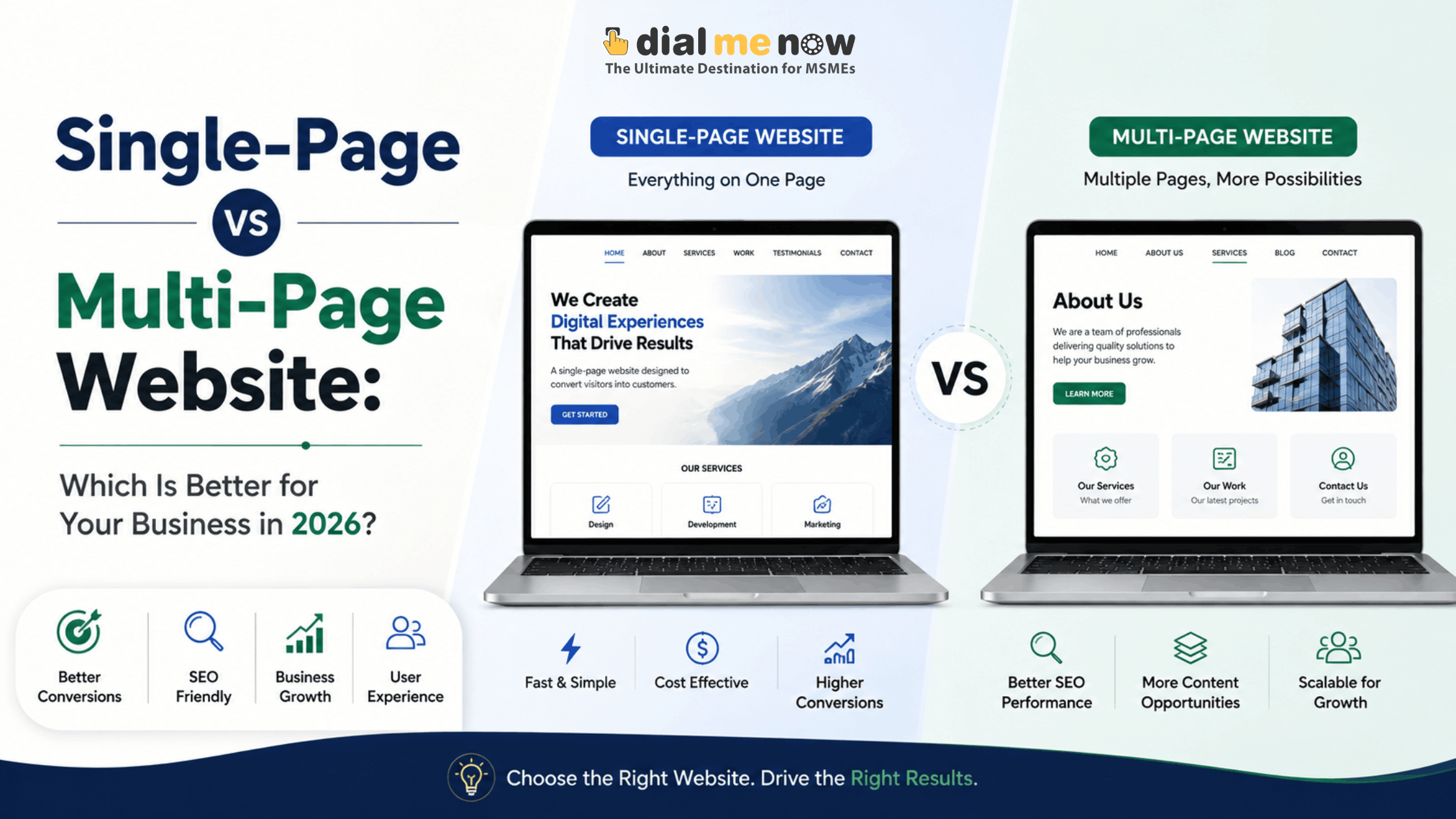
Quick AnswerA single-page website is suitable when a business has one focused offer, limited content and a simple conversion goal. A multi-page website is usually better when the company has multiple services, needs stronger SEO coverage, publishes content or expects the website to grow. The right choice depends on content depth and business goals, not simply budget. |
A business website can be a focused one-page experience or a larger structure with separate pages for services, about information, case studies, blogs and contact details.
Both formats can look professional. The difference is how much information the business needs to communicate and how visitors are expected to navigate it.
Choosing the wrong structure can create problems later. A single page may become overloaded as services grow, while a large multi-page site can be unnecessary for a simple campaign. The best format is the smallest structure that explains the business clearly today while allowing realistic future growth.
What Is a Single-Page Website?
A single-page website presents most important information on one primary page. Navigation links usually scroll visitors to sections such as About, Services, Benefits, Testimonials and Contact.
This format works well when the message is simple and the desired action is clear. It can also be effective for campaigns, product launches, portfolios or small businesses with a limited service range.
A one-page website should not be confused with a low-quality website. It can still include professional design, responsive layouts, analytics, forms, performance optimisation and strong calls to action.
What Is a Multi-Page Website?
A multi-page website separates major topics into dedicated URLs. A company may have a home page, About page, individual service pages, case studies, blog and Contact page.
This structure gives each topic more space and allows visitors to enter the website through different pages based on search intent.
It is generally easier to expand over time because new services, locations, resources or landing pages can be added without making the home page excessively long.
Single-Page vs Multi-Page: Key Differences
- Content: single-page sites work with concise information; multi-page sites support deeper service and educational content.
- Navigation: one-page navigation is linear; multi-page navigation lets users explore topics independently.
- SEO: multi-page sites provide more opportunities to target distinct search intents with dedicated pages.
- Maintenance: a simple one-page site can be easier to maintain; larger sites require stronger content governance.
- Conversion: a one-page flow can be excellent for one focused action; multi-page sites can support several audience journeys.
- Scalability: multi-page architecture generally handles future services and content more naturally.
- Development scope: one-page projects are often smaller, although design complexity and custom features still affect effort.
Which Is Better for SEO?
A multi-page website is usually more flexible for SEO because each important service or topic can have a dedicated page with its own title, content and internal links.
That does not mean a one-page website cannot appear in search results. It can perform well for a narrow business or branded search. The limitation is that one URL must represent many topics if the business tries to target several unrelated services.
For a company planning long-term organic growth, location pages, service pages and educational blogs, a multi-page structure normally provides a stronger foundation.
Which Is Better for Conversions?
Conversion performance depends on the offer and visitor journey.
A single-page website can convert very well when the visitor needs a straightforward explanation and one action, such as requesting a quote or registering interest. There are fewer navigation choices and the story can be carefully sequenced.
A multi-page website is better when visitors need to research before enquiring. Separate pages can answer detailed questions, build trust and allow each audience segment to follow a relevant path.
Choose a Single-Page Website When
- You have one main product, campaign or focused service.
- Business information can be explained clearly without excessive scrolling.
- SEO is not dependent on many separate service topics.
- You need a professional online presence with a straightforward enquiry goal.
- You do not expect frequent content expansion in the near future.
Choose a Multi-Page Website When
- You offer several distinct services or product categories.
- Organic search is an important growth channel.
- You need individual landing pages for locations or audiences.
- You publish blogs, case studies, resources or news.
- Customers need detailed information before enquiring.
- You expect the website to expand with new services or features.
- You want different conversion paths for different visitor intents.
Can You Start Small and Expand Later?
Yes, if the initial website is designed with expansion in mind.
A business can begin with a focused site and later introduce dedicated service pages, blogs or dynamic features. The development team should avoid architecture that makes expansion unnecessarily difficult.
Content planning is important even for a small site. Knowing which pages may be needed later can influence navigation, URLs and the way the first version is structured.
How Dial Me Now Can Help
Dial Me Now offers web and app development services and can create focused single-page websites as well as multi-page business websites.
The correct scope should reflect your services, target audience, SEO plans, content volume, integrations and future roadmap. Visit DialMeNow.in and submit an enquiry to discuss whether a single-page or multi-page website is the more practical choice for your business.
Frequently Asked Questions (FAQs)
1. Is a one-page website good for a small business?
Yes, especially when the business has a simple offering and primarily needs credibility, contact information and an enquiry path.
2. Can a single-page website rank on Google?
Yes, but it has fewer dedicated URLs for distinct topics, which can limit flexibility when targeting multiple service intents.
3. Is a multi-page website always more expensive?
It usually involves more content and development, but cost depends on design, features, CMS, integrations and custom functionality.
4. Which website type loads faster?
Either can be fast when built well. A very long one-page site can become heavy, while a poorly optimised multi-page site can also be slow.
5. Can a one-page site have a blog?
A blog normally introduces additional URLs, so the overall website would no longer be strictly single-page.
6. Which is better for Google Ads?
A focused landing page can work very well for a specific campaign, while a multi-page website can support broader research and trust.
7. Can we convert a single-page website into multi-page later?
Yes, especially if the initial design and technology are planned for future expansion.
8. Do multi-page websites confuse users?
Not when navigation is clear and information architecture is organised around user needs.
9. How many pages should a business website have?
There is no fixed number. Create a separate page when a topic deserves its own useful content and visitor journey.
10. Should each service have its own page?
If services are meaningfully different and customers search or decide based on them separately, dedicated pages are often useful.
Conclusion
A single-page website is not automatically basic, and a multi-page website is not automatically better. The right structure depends on how much information your business needs to communicate and how customers discover and evaluate you.
Choose one page for a focused offer and simple journey. Choose multiple pages when services, SEO, content and future growth require greater depth.
To plan a professional website around your actual business goals, visit DialMeNow.in and submit your requirements to the Dial Me Now team.
| Ready to discuss your requirement? Visit DialMeNow.in or use the Contact Us page to submit your enquiry. |
Suggested Internal Links for This Series
- What Makes a Good Business Website? 12 Features Every Modern Website Should Have
- Instagram, Facebook or Your Own Website: What Does a Small Business Really Need?
- From a Simple One-Page Website to a Complete Business Website: Build Your Online Presence with Dial Me Now
Disclaimer
This article provides general website-planning information. SEO performance, conversion rates, development cost and page requirements vary by business, content quality, competition, technology and marketing strategy.